

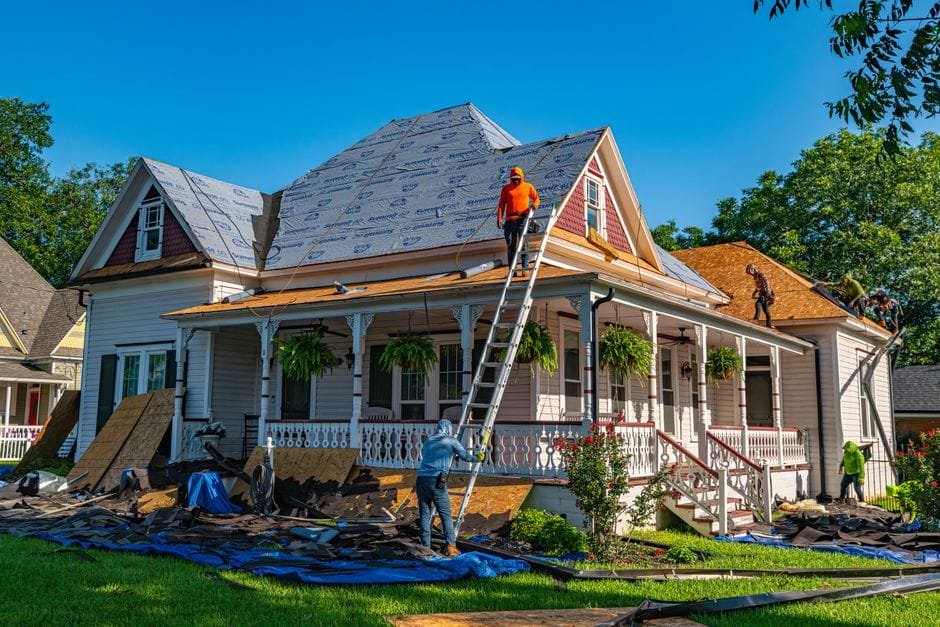
What You Need to Know Before Starting a Roof Replacement
A roof replacement is one of the biggest home investments you’ll make — typically costing $6,000 to $30,000 for a single-family home, with most Kansas City area homeowners paying somewhere between $8,000 and $18,000.
Here’s a quick snapshot of what to expect:
| What You’re Wondering | Quick Answer |
|---|---|
| Average cost (2,000 sq ft, asphalt) | ~$11,000 nationally; $8,000–$15,000 in the KC Northland area |
| How long a new roof lasts | 25–30 years (asphalt); 40–70 years (metal) |
| Does insurance cover it? | Yes, for storm damage — not for age or wear |
| How long does it take? | 1–3 days of active work; 6–8 weeks start to finish |
| Best time of year to replace | Spring or fall for mild weather and potential discounts |
| Signs you need replacement | Curling shingles, granule loss, sagging deck, recurring leaks |
Most homeowners only deal with a roof replacement once or twice in their lifetime. But when the time comes — especially after a hailstorm or years of Missouri weather — the decisions come fast. Which material? Which contractor? Will insurance pay? How much should this actually cost?
This guide answers all of it, clearly and without fluff.
I’m Greg Nakata, owner of GNAK Roofing Services in Kearney, MO — and my background in commercial real estate finance, asset underwriting, and insurance documentation gives me an unusually detailed lens when evaluating a roof replacement project. That perspective shapes everything in this guide, so you can make a confident, well-informed decision before a single shingle comes off your home.
Repair vs. Replacement: How to Decide

Every homeowner hopes for a simple, cheap repair when they spot a leak. No one wakes up excited to buy a new roof. However, patching a system that is fundamentally failing is like putting a band-aid on a sinking ship — it only delays the inevitable and often costs you more in compounding interior water damage.
To make an objective decision, we always recommend starting with a professional evaluation. You can learn more about what we look for during this process by checking out our roof inspection services.
When evaluating whether to repair or replace, we look at several critical indicators:
- The 30% Rule: This is a reliable industry benchmark. If the cost to repair your current roof’s localized issues exceeds 30% of the total cost of a full replacement, it is financially smarter to invest in a new roof.
- Roof Age: Standard 3-tab asphalt shingles are designed to last 15 to 20 years, while modern architectural shingles typically last 25 to 30 years. If your roof is approaching or has passed these thresholds, its materials are naturally reaching the end of their service life.
- Granule Loss: Shingles are coated with tiny mineral granules designed to shield the underlying asphalt core from the sun’s destructive UV rays. If you find piles of “roof sand” clogging your gutters, your shingles have lost their protective barrier and will rapidly become brittle and crack.
- Active, Recurring Leaks: A single leak from a localized puncture can easily be patched. But if you are chasing multiple leaks across different areas of your home, the water barrier has failed systemically.
- Sagging Decking: If you notice a wavy, spongy, or drooping appearance along the ridgelines or flat planes of your roof, it indicates that the underlying plywood decking has rotted from trapped moisture. This is a structural hazard that requires immediate attention.
When to Choose a Full Roof Replacement Over Repairs
Choosing a complete roof replacement becomes necessary when localized repairs can no longer guarantee structural integrity or protect your home from severe weather. In Missouri, where severe spring storms, hail, and high winds are common, a compromised roof is a major liability.
If a severe storm sweeps through Clay County or St. Joseph and causes widespread damage — such as bruising across the entire shingle field or tearing away large sections of roofing — a spot repair will not restore your home’s wind resistance. Furthermore, trying to patch an old, brittle roof often causes more damage, as walking on fragile shingles can fracture the surrounding areas.
To dive deeper into the lifespans, materials, and long-term timing of this project, take a look at this Complete 2026 Guide on Roof Replacement.
Cost-Effective Alternatives to a Complete Tear-Off
If your roof is showing signs of aging but the underlying structural decking is completely dry and intact, you might wonder if there are cheaper alternatives to a full, messy tear-off.
- Shingle Rejuvenation (e.g., Roof Maxx): This is a plant-based bio-oil treatment designed to restore flexibility to dry, brittle asphalt shingles. As shingles age, their natural petrochemical oils dry out, making them inflexible. A rejuvenation treatment can add up to 5 years of life to an aging roof and costs up to 80% less than a full replacement. However, this is a preservation treatment; it cannot fix active leaks, rotted wood, or structural sagging.
- Metal Overlays: This involves installing a lightweight metal roof directly over your existing asphalt shingles. It saves you the upfront labor and disposal costs of a complete tear-off. However, you must consider local building codes. In most Missouri jurisdictions, building codes permit a maximum of two roofing layers. If your home already has two layers of shingles, an overlay is not an option. Additionally, overlays prevent the contractor from inspecting the underlying plywood deck for hidden rot, and some manufacturers will reduce or void their product warranties on overlay installations.
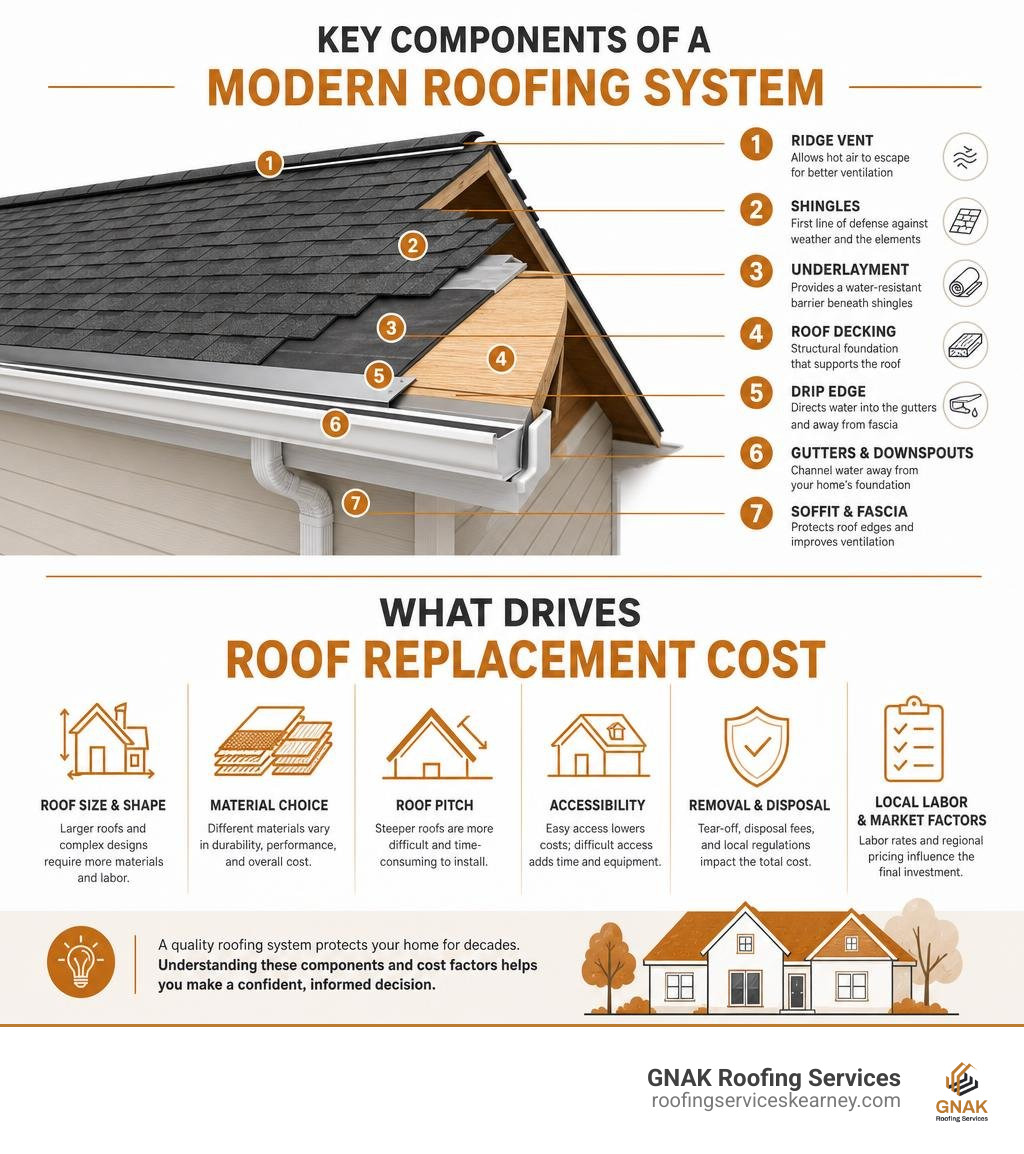
Key Factors That Determine Your Roof Replacement Cost
When you receive a quote for a roof replacement, the number isn’t pulled out of thin air. It is calculated using several physical and logistical variables. Understanding these factors will help you compare quotes objectively rather than simply choosing the lowest bid.
To get a clear baseline of current market pricing, you can review this 2026 Price Guide on Roof Replacement Costs.
- Roof Size and “Squares”: In the roofing industry, we do not measure projects by simple square footage. Instead, we use “squares.” One roofing square equals a 10-foot by 10-foot area, or 100 square feet. A 2,000-square-foot home with overhangs and a sloped pitch will typically require 22 to 26 squares of material.
- Pitch and Slope: The steepness of your roof drastically impacts labor costs. A standard, walkable pitch (up to 7:12) is straightforward to install. Any roof with a pitch steeper than 7:12 is considered “non-walkable.” It requires specialized safety scaffolding, harnesses, and slower, more meticulous labor, which increases the installation cost.
- Architectural Complexity: A simple gable roof with two flat planes is the most affordable style to replace. If your roof features hips, valleys, dormers, chimneys, or skylights, the price increases. Water moving across a complex hip-and-valley system has many more opportunities to find a seam, requiring extra flashing, underlayment, and labor to seal properly.
- Labor and Regional Pricing: Labor typically accounts for 40% to 50% of your total invoice. These rates are heavily driven by local worker’s compensation insurance and regional living costs. While coastal markets see much higher rates, the Midwest and Kansas City Northland areas generally enjoy labor costs that run slightly below the national average.
Comparing Roofing Materials: Cost vs. Lifespan
The material you select is the largest variable under your control. While it is tempting to focus solely on the upfront price, the smartest way to evaluate roofing materials is on a cost-per-year-of-service basis.
| Material Type | Upfront Cost (per Square) | Expected Lifespan | Cost-per-Year of Service |
|---|---|---|---|
| Standard 3-Tab Asphalt | $80 – $130 | 15 – 20 Years | $450 – $650 |
| Architectural Asphalt | $100 – $180 | 25 – 30 Years | $350 – $550 |
| Standing-Seam Metal | $300 – $800 | 40 – 70 Years | $350 – $550 |
| Synthetic / Composite | $300 – $700 | Up to 50 Years | $400 – $600 |
| Clay / Concrete Tiles | $300 – $1,100 | 40 – 50 Years | $500 – $900 |
| Natural Slate | $600 – $1,600 | 100+ Years | $280 – $680 |
- Asphalt Shingles: This remains the most popular choice for homes in Kearney, Liberty, and Independence. While standard 3-tab shingles are cheap, architectural shingles offer significantly better wind resistance (rated up to 110–130 mph) and a much cleaner, dimensional look.
- Metal Roofing: Installing a high-quality metal roofing system is a fantastic way to protect your home. Standing-seam metal systems reflect solar heat, easily shed heavy winter snow, and resist hail damage. Over 50 years, a $35,000 metal roof actually costs less per year ($700/year) than replacing a $15,000 asphalt shingle roof twice ($882/year).
- Slate and Tile: These are premium, heavy-weight materials. While natural slate can last over a century, it requires a reinforced home framing structure to handle the immense weight, making the initial installation highly specialized and expensive.
- Wood Shakes and Synthetics: Synthetic composite shingles mimic the gorgeous, rustic look of slate or wood shakes at a fraction of the weight, offering excellent impact resistance without requiring structural reinforcement.
The Step-by-Step Roof Replacement Process
A professional roof replacement is a highly coordinated, multi-step construction project. Here is how the process works from start to finish:
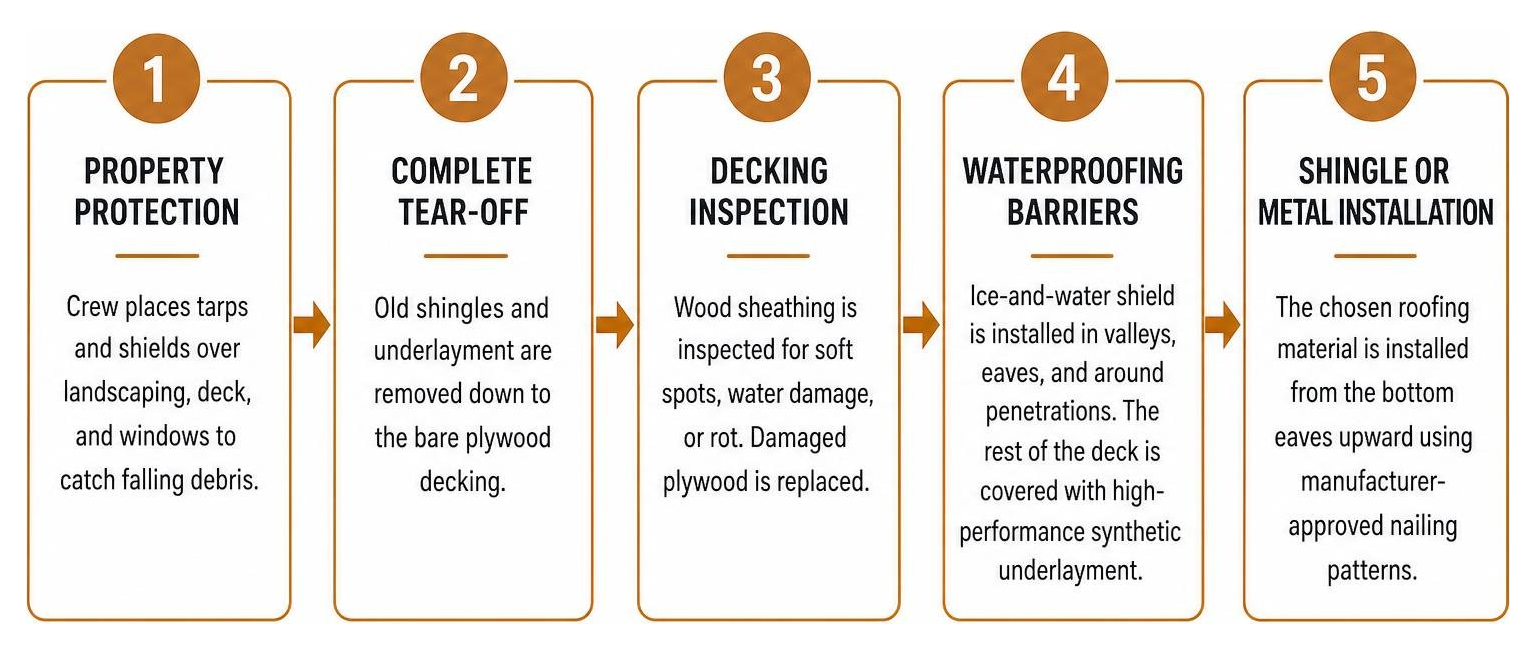
- Property Protection: Before any work begins, the crew will place tarps and wooden shields over your landscaping, deck, and windows to catch falling debris.
- Complete Tear-Off: We strip the old shingles and underlayment down to the bare plywood decking. Layering new shingles over old ones is a shortcut we do not recommend, as it hides structural damage.
- Decking Inspection: We inspect the wood sheathing for soft spots, water damage, or rot. Any damaged plywood sheets are replaced to ensure a solid foundation.
- Waterproofing Barriers: We install a self-healing ice-and-water shield in high-stress areas like valleys, eaves, and around chimneys to protect against ice dams. Then, we cover the remaining deck with a high-performance synthetic underlayment, which is far more tear-resistant than old-fashioned felt paper.
- Shingle or Metal Installation: The chosen roofing material is installed starting from the bottom eaves and working upward, using precise nailing patterns that comply with manufacturer specifications.
- Flashing and Ventilation: New metal flashing is installed around chimneys, skylights, and valleys. We also install or upgrade your ridge vents to ensure balanced attic ventilation, preventing heat and moisture buildup.
- Cleanup and Magnetic Sweep: The crew cleans your yard, clears the gutters, and runs high-powered magnetic sweeps across your lawn and driveway to collect stray nails.
- Final Quality Inspection: A supervisor performs a final walk-through to ensure every detail meets our strict standards and local building codes.
Navigating Insurance, Warranties, and Contractor Quotes

When comparing quotes, the cheapest estimate is rarely the best option. Often, a low-ball quote completely omits critical items like permit fees, cleanup, or a decking replacement allowance — meaning you will face unexpected change orders once your old roof is torn off.
Always insist on an itemized, line-by-line quote. Verify that the contractor is fully licensed and carries at least $1,000,000 in general liability insurance along with worker’s compensation. If your project involves a commercial property, make sure you hire a team with specific experience in flat-roof systems and safety protocols, which you can learn more about on our commercial roof replacement page.
Additionally, if your contractor uses subcontractors, always request a lien waiver upon final payment. This legal document protects you from financial liability if the primary contractor fails to pay their material suppliers or crews.
Understanding Homeowners Insurance: RCV vs. ACV
If your roof was damaged by a sudden, accidental event like a windstorm, tornado, or hailstorm, your homeowners insurance will likely cover the replacement. However, how much you pay out-of-pocket depends entirely on your policy type:
- Replacement Cost Value (RCV): This is the ideal policy. Your insurer will cover the actual current cost to replace your roof with a brand-new equivalent, minus your deductible. They typically pay in two checks: a partial payment upfront to purchase materials, and a second check once the work is completed and documented.
- Actual Cash Value (ACV): This policy only pays for what your old roof was worth at the time of the damage. The insurer calculates the replacement cost and subtracts depreciation based on your roof’s age. For example, if a 20-year-old roof is damaged, an ACV policy may only pay out a fraction of the actual replacement cost, leaving you to cover the rest out-of-pocket.
Note: Many insurance companies automatically transition your coverage from RCV to ACV once your roof reaches 15 to 20 years of age. Check your policy renewal documents carefully.
Additionally, be aware of your deductibles. In storm-prone regions like Kansas City, wind and hail deductibles are often percentage-based (e.g., 1% to 2% of your home’s total insured value) rather than a flat fee, which can result in higher out-of-pocket costs. Finally, never hire a contractor who offers to “waive” your deductible. This is insurance fraud, and reputable local companies will not participate in it.
On the bright side, installing a new, code-compliant roof can qualify you for significant insurance premium discounts, especially if you choose impact-resistant Class 4 shingles.
Decoding Manufacturer and Workmanship Warranties
When investing in a new roof, you should expect two distinct types of protection:
- Manufacturer Product Warranties: These cover defects in the roofing materials themselves, such as premature cracking or bald spots. Standard warranties last 20 to 50 years. However, there is a major loophole: if the manufacturer determines that your roof failed because the contractor did not install the materials according to their exact specifications, they will void your warranty.
- Workmanship Warranties: This is the warranty provided by your contractor, covering their installation labor. A workmanship warranty protects you from installation errors, such as improper flashing or poor nailing.
At GNAK Roofing Services, we close this gap by combining manufacturer-compliant workmanship with certified installation practices. This ensures your manufacturer warranty remains fully valid and registered.
Frequently Asked Questions About Roof Replacement
Will a new roof increase my home’s resale value?
Yes, absolutely. A new, high-quality asphalt shingle roof typically returns roughly 60% to 70% of its cost in increased home value at resale. Beyond the raw appraisal numbers, a new roof is a massive selling point. Prospective buyers are often intimidated by the prospect of buying a home that needs immediate structural work. Seeing a fresh, modern roof with transferable warranties increases buyer confidence and helps your home sell faster.
What are the most common signs of hidden roof damage?
Not all roof damage is visible from your driveway. The most common signs of hidden damage include:
- Attic Daylight: If you climb into your attic on a sunny day and see pinpricks of light shining through the roof boards, water can get in too.
- Water Stains and Mold: Dark rings or water stains on your attic rafters, ceilings, or upper walls indicate slow, active leaks.
- Damaged Flashing: Cracked, rusted, or lifting metal flashing around your chimney or valleys is a primary source of hidden water intrusion.
How can I maintain my roof to extend its lifespan?
Simple, proactive maintenance can add years to your roof’s life:
- Gutter Cleaning: Clean your gutters at least twice a year to prevent water from backing up under your shingles.
- Tree Trimming: Trim overhanging branches to keep them from scraping your shingles or crashing down during a storm.
- Moss and Algae Removal: Treat early-stage moss or algae growth promptly to prevent the roots from lifting and warping your shingles.
- Regular Inspections: Have a professional inspect your roof every few years, especially after major hail or wind events.
Conclusion
A roof replacement is a significant investment, but it is also your home’s first line of defense against the elements. By understanding the factors that drive costs, comparing materials on a cost-per-year basis, and vetting your contractor thoroughly, you can transform a stressful home repair into a smooth, rewarding upgrade.
At GNAK Roofing Services, we are proud to serve our neighbors throughout Kearney, Clay County, Liberty, Independence, St. Joseph, and the greater Kansas City area. We combine deep local expertise with insurance-ready documentation and manufacturer-compliant workmanship to give you complete peace of mind.
Ready to protect your home with a roof built to last? Schedule a Residential Roof Replacement with our experienced team today.