

When Your Roof Is Failing, Here’s What You Need to Know First
Roof repair is one of the most urgent home maintenance issues a property owner can face — and one of the most misunderstood.
Here’s a quick summary of the most important things to know:
- Most common causes: Cracked flashing, damaged vent boots, clogged gutters, storm damage, and ice dams
- Repair vs. replace: If your roof is under 15 years old and damage is localized, repair is almost always the better choice
- Typical repair costs: Minor repairs run $300–$800; moderate repairs $800–$2,500; major repairs $2,500 and up
- Insurance: Sudden storm damage (wind, hail, fallen trees) is typically covered — normal wear and tear is not
- When to act: The moment you see water stains, missing shingles, or granules in your gutters, call a professional
Every roof has a limited lifespan. Exposure to sun, wind, rain, and temperature swings gradually breaks down shingles, sealants, and flashing. When a small problem goes unaddressed, water finds its way in — and what starts as a minor fix can quietly turn into rotted decking, damaged insulation, or mold growth inside your home.
The good news? Most roof problems are fixable without a full replacement — if you catch them early and work with the right contractor.
I’m Greg Nakata, owner of GNAK Roofing Services in Kearney, MO, and my background in commercial real estate finance and asset underwriting since 1999 gives me a different lens on roof repair than most contractors — one focused on accurate documentation, material compliance, and protecting your long-term investment. In this guide, I’ll walk you through everything you need to make a smart, informed decision about your roof.
Common Causes of Roof Leaks and Damage
Understanding what causes a roof to fail is the first step toward protecting your home. In our years of providing residential roof repair and commercial roof repair across the Kansas City Northland, we have identified several recurring culprits.
Surprisingly, the root cause of a leak isn’t always wear and tear. Industry statistics show that 60–70% of roof leakage problems are due to incorrect application or installation by unqualified crews. When shingles aren’t nailed in the correct pattern, or flashing is poorly sealed, the roof is set up for failure from day one.
Here are the most common physical causes of roof leaks we address:
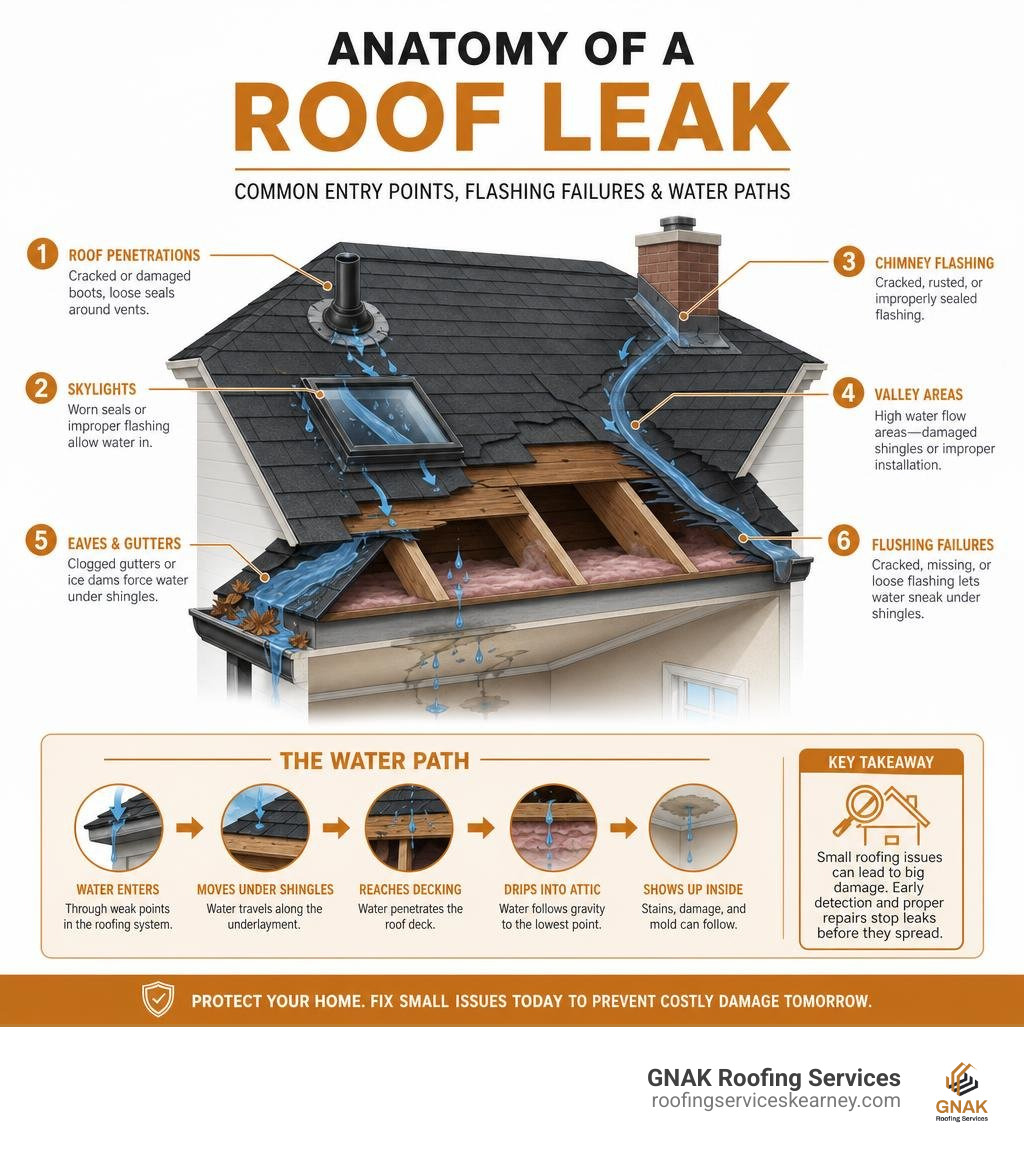
- Cracked Flashing: Flashing consists of thin metal sheets installed at transition points on your roof, such as valleys, chimney bases, and where the roof meets a wall. Over time, temperature fluctuations cause the metal to expand and contract, which can crack the protective sealant or pull the nails loose.
- Damaged Vent Boots: Vent boots are the rubber and plastic seals surrounding the pipes that exhaust air from your bathrooms and kitchen. Constant exposure to intense Missouri summer sun causes these rubber boots to rot, crack, and split, allowing water to run straight down the pipe into your attic.
- Roof Valleys: Valleys are the “V” shaped channels where two roof slopes meet. Because water flows in high volumes through these valleys to reach the gutters, any gap in the underlayment or valley flashing will quickly result in a major interior leak.
- Clogged Gutters: When gutters are packed with leaves and debris, water cannot flow freely to the downspouts. Instead, it backs up under the roof’s edge, rotting the fascia boards and finding its way under the bottom courses of shingles.
- Ice Dams: During cold Missouri winters, heat escaping from poorly insulated attics melts snow on the upper parts of the roof. As this water flows down to the cold roof edge, it refreezes, forming a block of ice. Water backing up behind this ice dam has nowhere to go but under the shingles.
- Attic Condensation: Sometimes, what looks like a roof leak is actually excess moisture inside your home. If your attic lacks proper ventilation, rising household humidity will condense on the cold underside of your roof decking, eventually dripping down onto your ceiling and mimicking a leak.
As of July 2026, building standards demand higher resilience from materials, but older installations frequently fall victim to these common weak points.

How to Locate and Diagnose a Roof Leak
Finding the exact source of a leak can feel like chasing a ghost. Water rarely travels in a straight line; it often enters through a crack in one spot, runs down a rafter, and drips onto your ceiling ten feet away.
To locate a leak, we use a systematic approach:
- The Attic Inspection: We start in the attic with a high-powered flashlight. We look for water stains, mold, or black rot along the rafters and the underside of the roof deck. If it has rained recently, we check for damp insulation or active drips.
- The Garden Hose Test: If the leak is stubborn and hard to find during dry weather, we perform a garden hose test. One technician stands on the roof with a hose, gently soaking specific areas (starting at the lowest point and working up), while another technician stays in the attic with a flashlight to watch for the exact moment water begins to penetrate.
- Diagnostic Technology: For complex or hidden leaks, we utilize advanced diagnostic tools. Infrared thermography (thermal imaging) allows us to detect temperature differences caused by trapped moisture under shingles, while moisture meters help us map out the exact boundaries of water damage.
Whether you are dealing with a minor drip or a major structural concern, diagnosing the root cause is essential before any physical repairs begin.
Roof Repair vs. Roof Replacement: Making the Right Decision
One of the most common questions we hear is: “Do I really need a new roof, or can I just patch this one?”
As a rule of thumb, we advise homeowners to look at the 25% rule. If more than 25% of your roof surface is damaged, or if we find scattered leaks across multiple independent sections, a full replacement is usually more cost-effective in the long run. However, if the damage is localized to a single area (like a damaged valley or a cracked vent boot) and the rest of the roof is in good structural shape, a targeted repair is the smartest financial choice.
Your decision should be based on three primary factors:
- Roof Age: Standard asphalt shingle roofs typically last 15 to 20 years. If your roof is under 15 years old and has minor storm damage, repair it. If it is 20+ years old and shingles are losing their protective granules, replacing it is often the better investment.
- Localized Damage: If a fallen tree limb damages a few shingles on one slope, there is no need to replace the entire system. We can easily perform localized shingle and decking repairs.
- Structural Integrity: If water has been leaking undetected for months and has rotted the underlying plywood decking, a simple patch won’t suffice. The rotted wood must be cut out and replaced, which may require a larger-scale residential roof replacement or commercial roof replacement depending on the building type.
| Factor | Roof Repair | Roof Replacement |
|---|---|---|
| Average Cost | $300 to $1,000 (Up to $3,000) | $5,000 to $10,000 (Up to $16,000) |
| Typical Lifespan | Extends existing roof life by 2–5 years | Lasts 15 to 50+ years depending on material |
| Best For | Localized damage, budget constraints, newer roofs | Widespread leaks, aging shingles, structural rot |
| Warranty | Covers the repaired area only | Full manufacturer and workmanship warranties |
If you are unsure of your roof’s current condition, scheduling professional roof inspection services is the best way to get an honest, unbiased assessment.
Understanding the Cost of Roof Repair
Roofing costs vary based on the severity of the damage, the pitch of your roof, and the materials required. Here is a breakdown of what you can typically expect to pay for professional repairs:
- Minor Repairs ($300 – $800): This includes basic maintenance tasks such as replacing a single damaged shingle, refreshing old caulking around flashing, sealing exposed nail heads, or replacing a single cracked vent boot.
- Moderate Repairs ($800 – $2,500): These projects involve fixing leaks in high-stress areas. Examples include replacing chimney flashing, rebuilding a damaged roof valley, repairing localized wood rot in the decking, or sealing a leaking skylight.
- Major Repairs ($2,500 and up): Major repairs involve structural work, such as replacing large sections of rotted decking after a tree limb impact, rebuilding collapsed fascia and soffit systems, or correcting significant attic ventilation issues.
In comparison, a full roof replacement is a much larger capital expense, averaging between $5,000 and $10,000 for standard asphalt shingles, and reaching up to $16,000 or more for premium materials like metal or tile. By addressing minor issues early, you can avoid these higher costs.
The Professional Restoration Process
At GNAK Roofing Services, we believe in doing things right the first time. We adhere to strict installation standards to ensure your repair lasts as long as the surrounding roof.
Here is what you can expect during our professional repair process:
- Detailed Inspection: We don’t just patch the visible damage. We conduct a thorough audit of the surrounding area to identify the root cause of the leak.
- Site Preparation: We protect your landscaping, driveway, and outdoor furniture by laying down heavy-duty tarps.
- Material Matching: We match the color, style, and manufacturer of your existing shingles as closely as possible to maintain your home’s curb appeal. We work with top-tier brands like GAF (maker of Timberline, America’s #1-selling shingle) to ensure compatibility.
- Proper Fastening: We follow manufacturer-specified nailing patterns and use corrosion-resistant fasteners. Incorrect nail placement is a major cause of wind blow-offs, so we ensure every nail is driven straight and flush.
- Thorough Cleanup: Once the repair is complete, we perform a meticulous cleanup of your yard. This includes a full magnetic sweep to collect loose nails, protecting your family, pets, and car tires.

For larger properties, we also offer specialized commercial roof inspection and repair workflows designed to minimize disruption to your business operations.
How Long Does a Typical Roof Repair Take?
Most residential roof repairs are surprisingly fast. If the damage is localized, our crew can usually complete the work in one day.
However, several factors can affect the timeline:
- Weather Conditions: For safety and quality reasons, we do not perform roofing work during active rain, snow, or high winds. Attempting to apply sealants or shingles on a wet roof compromises the adhesive bond and can void manufacturer warranties.
- Scope of Damage: If we uncover hidden wood rot under the shingles, we must pause to replace the structural decking, which adds time to the project.
- Emergency Tarping: If your roof is actively leaking during a storm, we prioritize emergency tarping to stop immediate water damage, returning to complete the permanent repair once the weather clears.
Navigating Homeowners Insurance and Storm Damage
Living in the Kansas City Northland means dealing with unpredictable Midwestern weather. According to the National Oceanic and Atmospheric Administration, severe storms can bring high winds, heavy thunderstorms, and severe hail that cause sudden, significant damage to your roof.
If your home has been hit by a storm, here is how the insurance process works:
- What is Covered: Homeowners insurance typically covers sudden, accidental damage caused by wind, hail, or fallen trees. For example, if a severe storm tears shingles off your roof, your policy will likely cover the repair or replacement.
- What is Excluded: Insurance does not cover normal wear and tear, age-related deterioration, or damage resulting from neglect. If your roof is leaking because it is 25 years old and has never been maintained, the claim will likely be denied.
- The Documentation Process: This is where GNAK Roofing Services stands out. From my background in asset underwriting, we provide “insurance-ready” documentation. We take detailed before-and-after photographs, write up comprehensive damage assessments, and meet directly with your insurance adjuster on-site to ensure all storm-related issues are accurately documented.
If you suspect storm damage, contact us directly for a professional inspection to assess the condition of your roof and document any issues for your insurance claim.
Preventative Maintenance and Extending Roof Lifespan
The best way to save money on roof repairs is to prevent them from happening in the first place. By following a regular maintenance schedule, you can easily extend the lifespan of your roof by several years.
Here are our top roofing tips & maintenance strategies:
- Schedule Annual Inspections: Have your roof professionally inspected at least once a year, ideally in the spring or fall. Catching a small crack in the flashing today can prevent a major ceiling leak next winter.
- Clean Your Gutters: Keep your gutters and downspouts clear of leaves, twigs, and shingle granules. This ensures water drains away from your roof and foundation.
- Trim Tree Branches: Cut back overhanging tree limbs. Heavy branches can scrape against shingles during high winds, wearing away their protective coating, while falling leaves trap moisture on the roof surface. Keeping trees trimmed is a simple yet highly effective way to protect your roof from physical damage.
- Improve Attic Ventilation: Ensure your attic has balanced airflow. A combination of soffit vents (for intake) and ridge vents (for exhaust) keeps your attic cool in summer and dry in winter, preventing condensation and ice dams.
- Install Ice and Water Shield: When replacing or repairing roof valleys and eaves, always install a self-adhering ice-and-water barrier. This rubberized membrane provides a watertight seal beneath the shingles, protecting your home from wind-driven rain and ice dams.
For more helpful guides on preserving your home’s exterior, check out our blog or see what our clients say on our testimonials page.
Safety Precautions During Roof Inspections
While we encourage homeowners to keep an eye on their roofs, we strongly advise against climbing up there yourself. Roofing is inherently dangerous, and a single slip can result in severe injury.
If you must inspect your roof, follow these safety guidelines:
- Inspect from the Ground: You can spot 90% of roofing issues (like missing shingles, sagging lines, or damaged flashing) from the safety of your yard using a pair of binoculars.
- Ladder Safety: If you must use a ladder to clean gutters, ensure it is set on stable, level ground. Secure the ladder at the top, and always maintain three points of contact (two hands and one foot, or two feet and one hand) while climbing.
- Avoid Wet Roofs: Never walk on a wet, icy, or debris-covered roof. Asphalt shingles become extremely slick when damp, and morning dew can be just as hazardous as a rainstorm.
- Leave It to the Pros: If you suspect an active leak or need to inspect steep slopes, call a certified professional. We have the safety harnesses, specialized footwear, and training required to navigate roofs safely.
Frequently Asked Questions
What are the signs that my roof needs immediate attention?
You should call a professional immediately if you notice any of the following warning signs:
- Active water leaks or dripping water inside your home.
- Visible water stains (brown rings) on your ceilings or walls.
- A sagging ceiling, which indicates water is pooling on the drywall above.
- Daylight visible through the roof boards when looking up from your attic.
- Large sections of missing shingles after a storm, which leaves your roof deck completely exposed to the elements.
Will homeowners insurance cover my claim?
Your insurance coverage depends entirely on the cause of the damage. If the leak was caused by a sudden, accidental event — such as wind tearing off shingles or a hail storm damaging the asphalt mat — your policy will typically cover the repairs. However, if the leak is the result of aging materials, lack of maintenance, or normal wear and tear, the insurance company will likely deny the claim. We provide full documentation support to help you navigate this process smoothly.
Can I fix a leak myself?
While minor tasks like cleaning gutters are great DIY projects, we strongly advise against attempting to repair active leaks yourself. Applying hardware-store caulk over a leak is usually a temporary fix that masks the symptom without addressing the root cause. Furthermore, DIY repairs can void your shingle manufacturer’s warranty and pose serious safety hazards. Working with a certified, professional contractor ensures your repair is safe, durable, and compliant with building codes.
Conclusion
Your roof is your home’s first line of defense against the elements. While dealing with a roof leak can be stressful, catching the problem early and addressing it with targeted, professional repairs can save you thousands of dollars compared to an unnecessary full replacement.
At GNAK Roofing Services, we are proud to serve homeowners and businesses throughout Kearney, MO, and the surrounding Kansas City Northland. We combine our deep local knowledge of Missouri’s climate challenges with insurance-ready documentation and manufacturer-compliant workmanship to deliver repairs you can rely on for years to come.
Whether you need a quick shingle patch in St. Joseph, an inspection in Liberty, or reliable Roof Repair in Independence, MO, our team is here to help.
Ready to protect your property? Contact us today to schedule your professional inspection, or visit our FAQ page to learn more about our services. Let us help you keep a safe, dry roof over your head!