

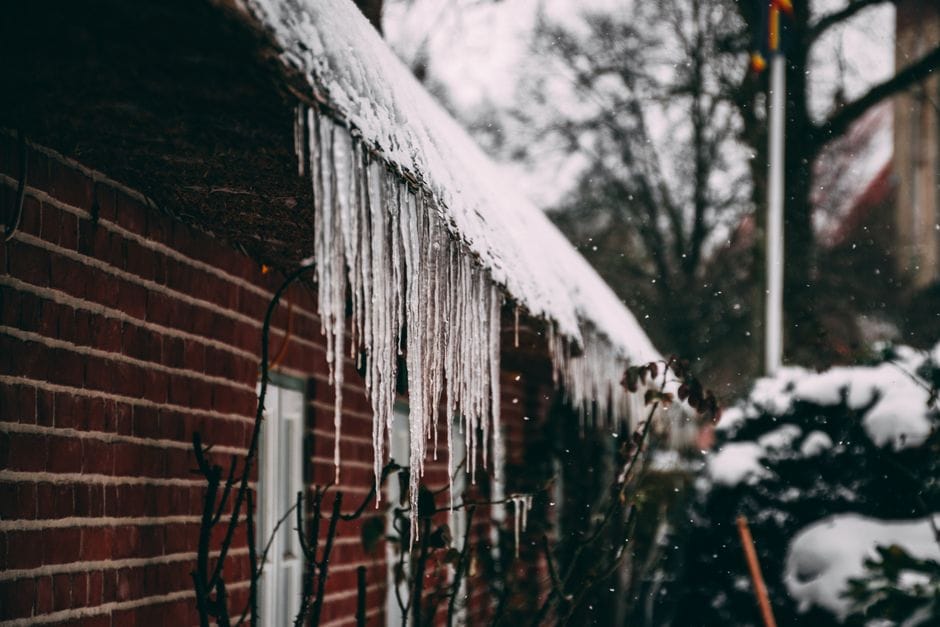
What Every Homeowner Should Know Before Filing an Ice Dam Insurance Claim
Filing an ice dam insurance claim catches many homeowners off guard — especially when they assume all winter storm damage is automatically covered.
Here’s the quick answer:
| Question | Short Answer |
|---|---|
| Is ice dam damage covered? | Usually yes, under standard HO-3 dwelling coverage |
| Is ice dam removal covered? | Usually no — treated as maintenance |
| What’s the average settlement? | Around $8,000 for interior damage |
| Top reason claims are denied? | Maintenance neglect (poor insulation or ventilation) |
| Can you appeal a denial? | Yes — state complaints succeed ~52% of the time |
Nearly one-third of U.S. homes — roughly 31.4 million — sit in areas where ice dams are a real threat. Yet most homeowners don’t realize how often these claims are underpaid, disputed, or denied outright. Water damage claims carry the highest denial rate of any claim type, at 9–10%.
The damage is also rarely just what you can see. A ceiling stain might represent only a fraction of the total moisture that has traveled through your roof deck, wall cavities, and insulation.
I’m Greg Nakata, owner of GNAK Roofing Services, and my background in commercial lending, asset underwriting, and collateral evaluation means I approach every ice dam insurance claim with the same documentation discipline insurers use internally. That experience shapes exactly how we help Kansas City area property owners build airtight claims from the start.
What is an Ice Dam and How Does It Form?
To understand how insurers evaluate an ice dam insurance claim, you first have to understand the science of how these icy ridges form.
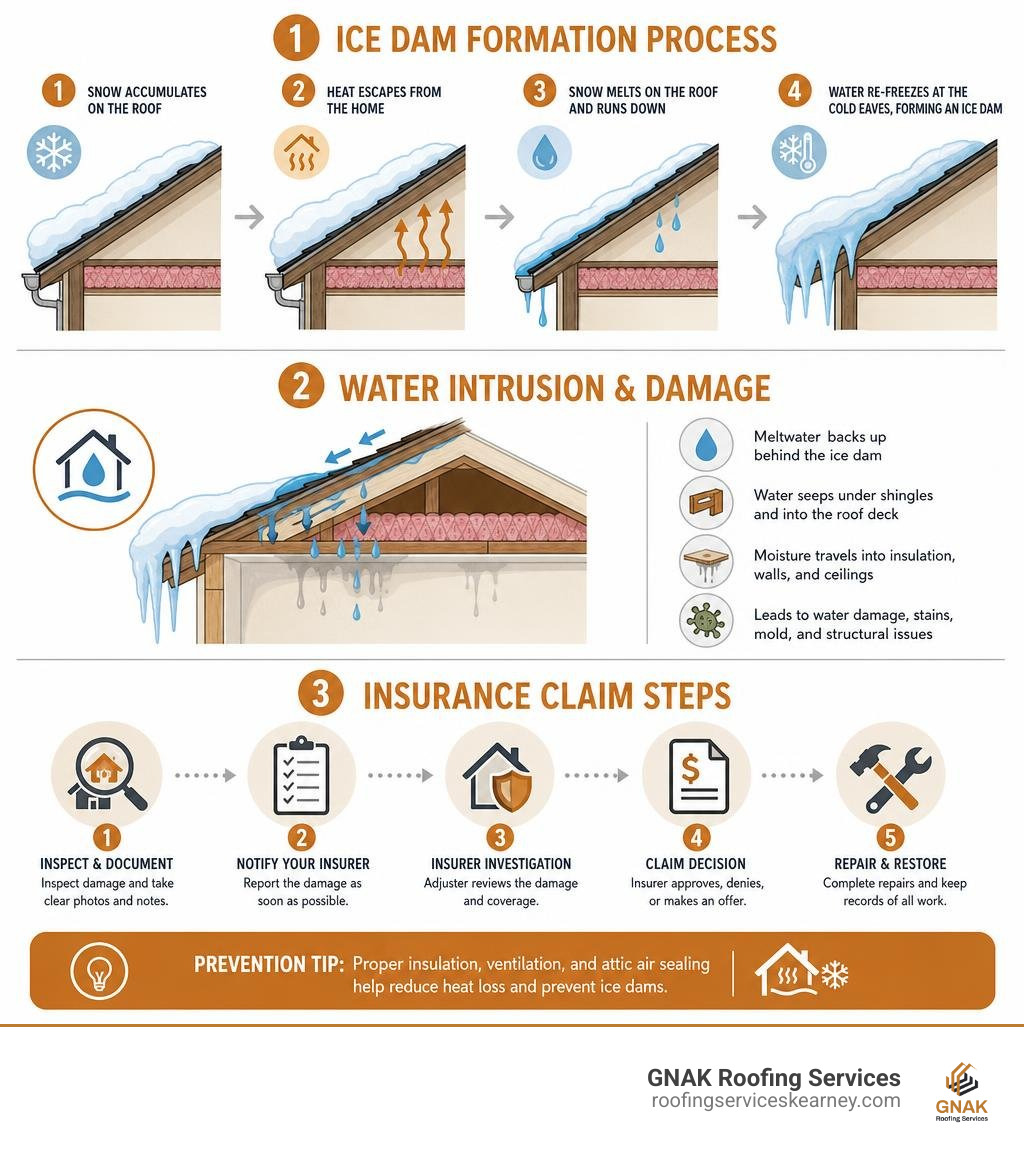
An ice dam is not just a massive icicle. It is a barrier of ice that forms at the edge of a roof, preventing melting snow from draining off. The process is driven by a specific freeze-thaw cycle:
- Attic Heat Loss: Heat escapes from the living spaces of your home into the attic due to poor insulation or unsealed bypasses. This warms the roof deck above freezing (32°F), even when the outdoor air is well below freezing.
- Snow Melt: The snow directly sitting on the warm upper sections of the roof begins to melt.
- Refreezing at the Eaves: As the meltwater trickles down the roof, it reaches the eaves and gutters. Because these overhangs extend past the heated footprint of the house, they remain at outdoor freezing temperatures. The water refreezes there, creating a ridge of ice.
- Gutter Blockage & Water Intrusion: As more snow melts, the water pools behind this growing ice ridge. With nowhere to drain, gravity forces the trapped water upward, backing it up under the shingles.
Once water gets beneath the shingles, it seeps through the roof deck, saturates the attic insulation, and leaks into your interior walls and ceilings.
While pitched roofs rely on gravity to shed water, low-slope roofs are especially vulnerable because standing water has more time to find pathways inside. Understanding these dynamics is essential for proper home care. For more information on maintaining your roof during harsh winter months, check out our guide on Roofing Tips & Maintenance.
Does Homeowners Insurance Cover an Ice Dam Insurance Claim?
The short answer is yes: standard HO-3 homeowners insurance policies generally cover the structural damage caused by ice dams. This coverage is typically filed under the “weight of ice, snow, or sleet” or “sudden and accidental water discharge” perils.
However, insurers draw a sharp line between the resulting damage and the cause of the ice dam.
Under standard dwelling coverage, your policy is designed to pay to repair the interior structure (like ruined drywall, framing, and plaster) and replace damaged personal property. It may also cover temporary living expenses if the water intrusion makes your home uninhabitable.
But insurers rely heavily on the ensuing loss doctrine. This legal principle states that even if the initial cause of the ice dam is excluded (such as poor attic ventilation or a lack of maintenance), the resulting water damage is still covered.
To understand how your insurer views winter weather events compared to general ice damage, you can read more about how Does my home insurance cover snow damage? – Liberty Mutual handles these events, or review the breakdown on Ice Dams vs. General Ice Damage: Why Insurers Treat Them Differently – Funari Public Adjusters.
To help clarify what you can expect to be covered, review this direct comparison:
| Covered Damages (Typically Allowed) | Excluded Damages (Typically Denied) |
|---|---|
| Interior ceiling and drywall repair | The cost of hiring a crew to steam-remove the ice dam |
| Replacement of saturated attic insulation | Repairing pre-existing rotted roof decking |
| Mitigation services (dehumidifiers and air movers) | Replacing gutters damaged purely by age or wear and tear |
| Replacement of water-damaged flooring and carpets | Mold remediation if the leak was left unaddressed for weeks |
What is Covered in an Ice Dam Insurance Claim?
When an ice dam backs water into your home, the physical damage inside your living space is the core of your claim. This typically includes:
- Interior Water Damage: Water dripping through ceiling light fixtures, down drywall, and pooling on floors.
- Drywall and Ceiling Repair: Replacing saggy, stained, or crumbling drywall.
- Wet Attic Insulation: Saturated insulation loses its R-value permanently. Insurers must cover its removal and replacement.
- Emergency Mitigation: The cost of hiring professional water restoration crews to set up industrial fans, dehumidifiers, and perform moisture mapping.
If you are dealing with active water intrusion from an ice dam, securing professional help is critical. We provide comprehensive Residential Roof Repair services throughout the Kansas City metro area to stop the leak at its source and document the structural damage for your carrier.
What is Excluded from an Ice Dam Insurance Claim?
Homeowners are often shocked to learn what is left off the insurance estimate. If you aren’t careful, you could face thousands of dollars in out-of-pocket costs due to standard policy exclusions:
- Ice Dam Removal Costs: Insurance carriers view the physical removal of the ice dam itself as preventive maintenance. Unless the dam is actively causing a sudden structural failure (like a partial roof collapse), they will rarely pay the $400 to $4,000 cost to have it steamed off. You can read more about this frustrating reality in the analysis on Ice Dam Damage Insurance Claims Usually Don’t End Well.
- Wear and Tear: If your shingles were already curling, missing, or past their useful life, the insurer may pro-rate your roof payout or deny the roof-repair portion of the claim.
- Gutter Damage: Bent or detached gutters caused by the weight of ice are often classified as wear and tear rather than sudden storm damage.
- Gradual Mold: While sudden water damage is covered, mold that develops over weeks because you delayed reporting the claim will be excluded.
How Insurers Evaluate Neglect vs. Sudden Damage
Because water damage claims have a high denial rate of 9–10%, insurance adjusters look closely for any sign of “maintenance neglect.”

When an adjuster arrives at your home — often 10 to 21 days after the initial freeze-thaw event — they will inspect your attic. If they find that your attic lacks adequate insulation (below modern R-value standards) or has blocked soffit vents, the insurance company may argue that the ice dam was a preventable maintenance issue rather than a sudden, accidental weather occurrence.
To combat this, you need to prove that a specific, extreme winter storm caused the rapid buildup. We recommend keeping records of any home improvements, such as attic insulation upgrades or roof ventilation installations.
If your carrier wrongfully denies your claim by citing the maintenance exclusion, you do have recourse. Policyholders who file formal complaints with their state insurance commissioner (such as the Missouri Department of Commerce and Insurance) see a favorable outcome approximately 52% of the time, resulting in either a full overturn of the denial (26.2%) or a compromised settlement (26.1%).
Step-by-Step Guide to Filing Your Claim
If you discover an ice dam leak, how you handle the first 48 hours will directly impact your payout. Follow this step-by-step process to protect your claim:
Step 1: Document Everything Before You Touch Anything
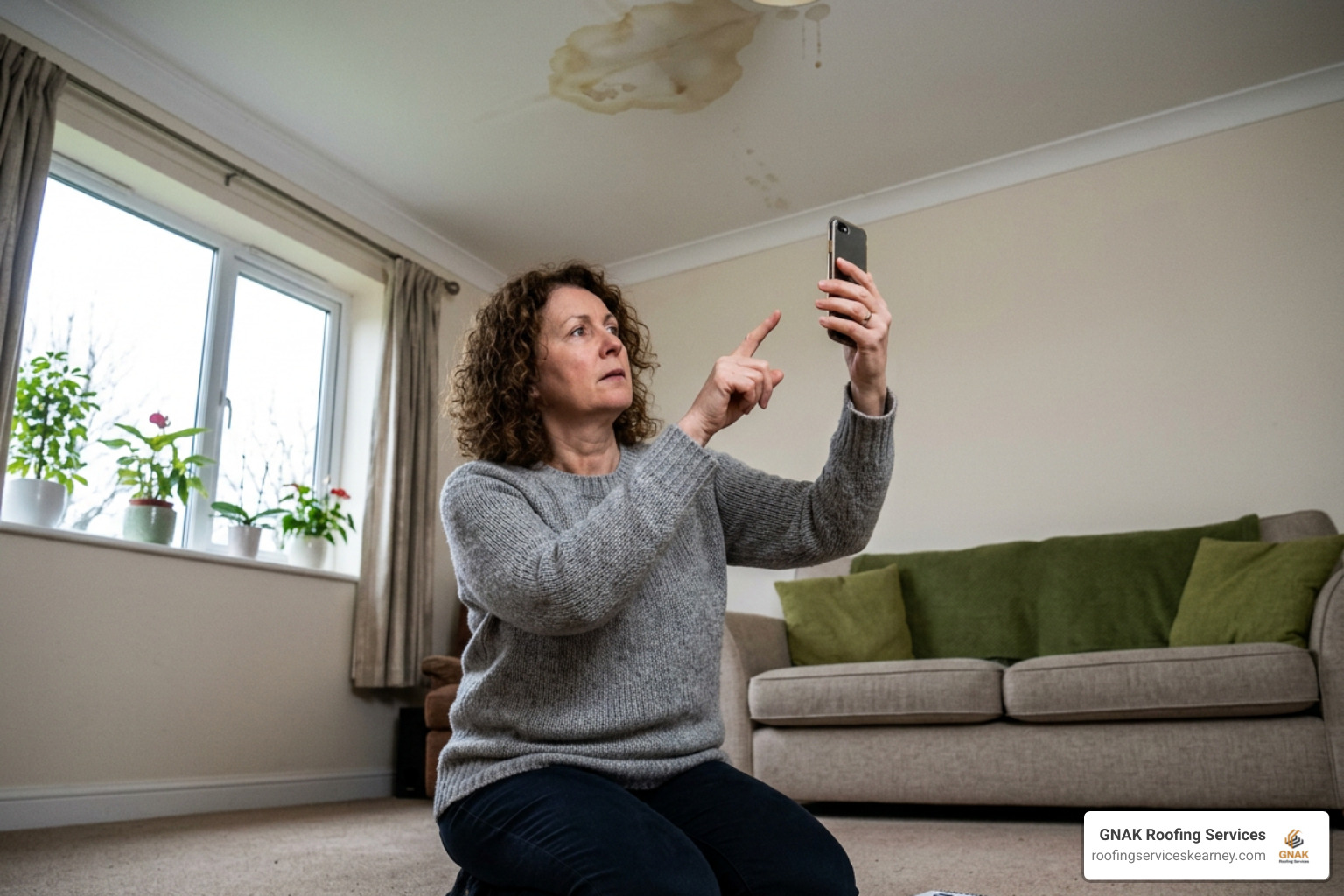
Take clear photos and videos of the ice dam on your roof, the clogged gutters, and every single interior water stain. Use a mobile app to apply date and time stamps to your photos.
Step 2: Mitigate Further Damage
You are contractually obligated under your policy to prevent further damage. Place buckets under active drips, lay down plastic sheeting, and run household fans. If you hire a professional to steam-remove the ice dam, keep the invoice. Frame this cost to your adjuster as “emergency mitigation to prevent further interior collapse,” which is sometimes covered.
Step 3: Get an Independent Inspection
Do not rely solely on the insurance company’s adjuster to scope the damage. Contact a trusted local contractor to perform a thorough inspection. For an expert, insurance-ready evaluation in Clay County or St. Joseph, schedule our Roof Inspection Services.
Step 4: File the Claim Promptly
Submit your claim along with your photo evidence and independent repair estimates. For a deeper look at navigating this initial filing process, read the guide on How to File an Ice Dam Insurance Claim – Stark Loss Consultants, Inc. or consult resources on Navigating Ice Damage: A Comprehensive Guide to Filing Insurance ….
When to Hire a Public Adjuster for Your Claim
For minor claims where the damage is limited to a small ceiling stain, working directly with your insurance company is usually straightforward. However, if water has traveled behind your walls, saturated your insulation, or affected multiple rooms, you may want to consider professional representation.
An independent public adjuster works directly for you, not the insurance company. According to public adjuster payout studies, policyholders who use a public adjuster receive, on average, significantly higher settlements than those who file alone. For non-catastrophe claims, the average settlement with a public adjuster is $9,379 compared to just $1,391 for those who file alone — a 574% increase.
A public adjuster is especially beneficial for:
- Identifying Hidden Moisture: Water frequently settles in wall cavities and subfloors where it can’t be seen, requiring thermal imaging and moisture meters to detect.
- Disputed Claims: If your insurer claims the damage is due to “wear and tear” or “neglect,” an adjuster can help argue your case using weather data and policy language.
If you suspect structural damage to your roof decking or framing, we can work alongside your adjuster to provide accurate, manufacturer-compliant estimates for Residential Roofing repairs.
How to Prevent Ice Dams and Avoid Future Denials
The best way to handle an ice dam claim is to avoid having to file one in the first place. Taking proactive steps during the warmer months will protect your home and eliminate the risk of insurance denials:
- Air Sealing: Seal all attic bypasses, including light fixtures, plumbing stacks, and attic hatches, to prevent warm indoor air from escaping into your roof space.
- Upgrade Attic Insulation: Ensure your attic insulation meets modern building standards (typically R-49 to R-60 in cold climates) to keep heat inside your living spaces.
- Improve Roof Ventilation: Proper intake (soffit) and exhaust (ridge) vents keep your roof deck cold, preventing the snow on your roof from melting prematurely.
- Use a Roof Rake: Safely clear the bottom 3 to 4 feet of snow from your eaves after heavy snowfalls to prevent ice ridges from forming.
If you aren’t sure whether your roof is prepared for freezing winter temperatures, search for trusted Roofers Near Me to schedule a professional maintenance assessment.
Frequently Asked Questions About Ice Dam Claims
Does insurance cover the cost of ice dam removal?
Generally, no. Insurance companies view physical ice dam removal as preventive maintenance rather than a covered repair. However, if the ice dam is causing active, severe interior leaking, some insurers may cover the cost under your policy’s “emergency mitigation” clause to prevent a larger, more expensive claim. Always document the active leak before hiring a professional steam-removal service.
Can my claim be denied for poor attic insulation?
Yes, insurers can deny claims under the “maintenance neglect” exclusion if they can prove that chronic, unaddressed insulation or ventilation issues caused the damage over multiple seasons. Upgrading your insulation to meet local building codes and keeping detailed home maintenance records are your best defenses against this type of denial.
Will filing an ice dam claim raise my insurance rates?
It is possible. While a single weather-related claim is unlikely to result in policy non-renewal, filing any claim can lead to premium increases at your next renewal. If your estimated repair cost is only slightly higher than your deductible, it is often more cost-effective to pay for the repairs out of pocket to protect your claims history.
Conclusion
Navigating an ice dam insurance claim doesn’t have to be an overwhelming process. By understanding how ice dams form, documenting the damage immediately, and knowing what your policy covers, you can secure a fair settlement to restore your home.
At GNAK Roofing Services, we combine our local expertise in Kearney, Liberty, Independence, and the greater Kansas City area with insurance-ready documentation and manufacturer-compliant workmanship. We understand the local climate and the specific challenges Missouri winters present to your roof.
If you are dealing with winter storm damage or want to protect your home before the next freeze, visit our Roofing Services page to schedule a consultation with our experienced team.