

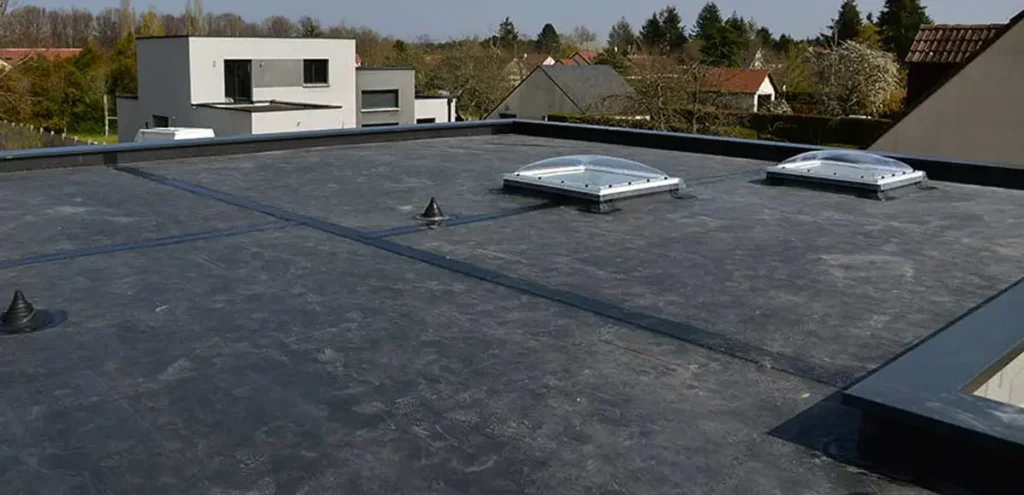
Does Hail Damage TPO Roofs? Here’s What Building Owners Need to Know First
TPO roofing hail damage is a real and serious risk for commercial and residential property owners — and it is often more dangerous than it looks.
Here is a quick answer to the most common questions:
| Question | Quick Answer |
|---|---|
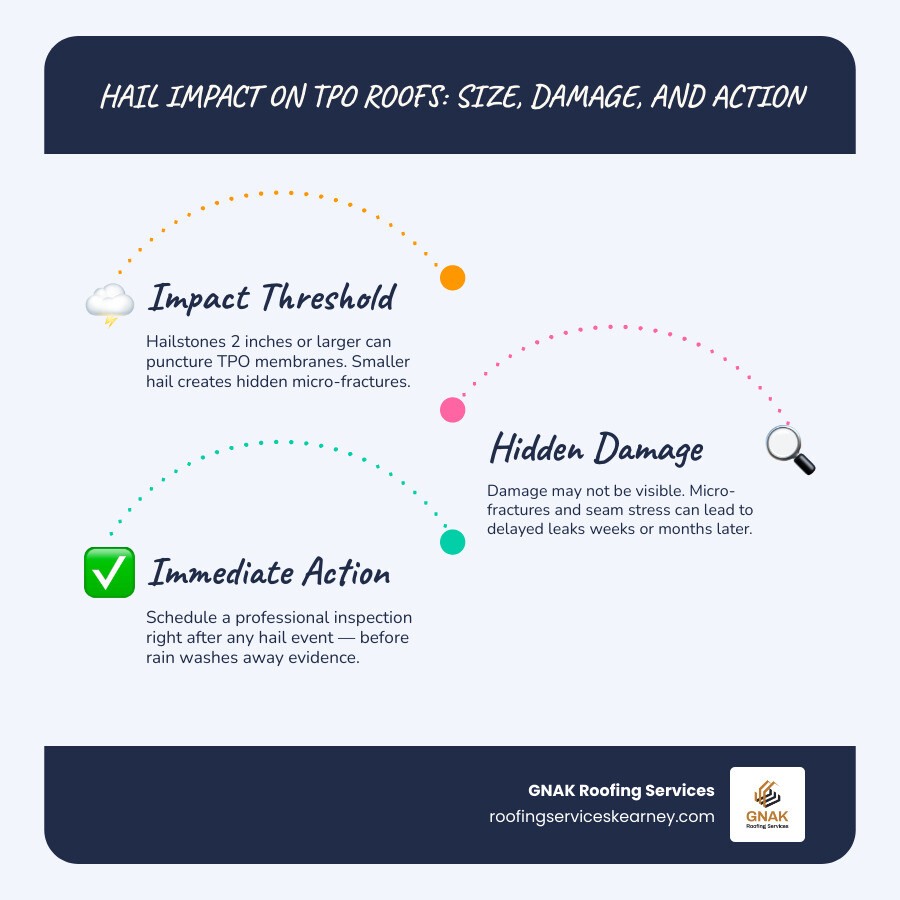
| What size hail damages TPO? | Hailstones over 2 inches in diameter can cause immediate punctures or fractures. Smaller hail can still cause hidden micro-fractures. |
| Is the damage always visible? | No. TPO hail damage is often hidden beneath the surface — in the membrane, seams, or insulation below. |
| Does it cause leaks right away? | Not always. Damage can sit undetected for weeks or months before water intrusion begins. |
| Should I get an inspection? | Yes — immediately after any significant hail event, before rain and environmental residue obscure the evidence. |
Most property owners only think about their roof when water starts dripping from the ceiling. By then, the damage from a hailstorm may have been silently growing for months — in the membrane, the seams, and the insulation underneath. Wind and hail damage alone accounted for 34.3% of all property damage claims nationwide in 2019, and that number keeps climbing.
The tricky part with TPO? A roof can look completely fine from the ground and still be structurally compromised.
I’m Greg Nakata, owner of GNAK Roofing Services in Kearney, Missouri. My background in commercial lending and asset underwriting since 1999 gives me an uncommon lens on tpo roofing hail damage — one focused on documentation, risk, and long-term cost — and I’ll walk you through everything you need to know to protect your property and your claim.
Identifying TPO Roofing Hail Damage: Visible and Hidden Signs
When hail strikes a Thermoplastic Polyolefin (TPO) roof, identifying the damage requires looking beyond obvious punctures. Because TPO is a single-ply, highly reflective membrane, it behaves differently under impact than asphalt or metal.
The physical indicators of a storm can be divided into visible surface markers and hidden structural issues. If you suspect your building has been hit, scheduling a professional Commercial Roof Inspection is crucial to catch these signs before they escalate.
- Spatter Marks: These are clean circular spots left on a dirty or weathered TPO membrane where the impact of the hailstone physically blasted away environmental dust, algae, or carbon buildup. While spatter marks themselves are not physical damage, they serve as a map showing exactly where the heaviest impacts occurred.
- Surface Dents and Creases: You may notice shallow, bowl-shaped depressions in the membrane. These occur when the hailstone crushes the rigid insulation board directly beneath the TPO.
- Concentric and Star-Shaped Fractures: Under close inspection, high-energy impacts reveal circular, concentric cracks or star-shaped fractures in the top weathering ply of the TPO. This indicates that the impact has broken the protective outer layer, exposing the scrim (the reinforcing polyester mesh) underneath.
- The “Bluish Tint” Exposure: TPO membranes are manufactured with a white top weathering layer and a darker (often grey or bluish) bottom layer. If a hailstone abrades or splits the top ply, you may see a distinct bluish or dark tint showing through the impact crater. This is a clear indicator of functional impairment.
- Seam and Flashing Disturbance: Hail striking near heat-welded seams can stress the weld. The kinetic energy can cause micro-tears along the seam edge, leaving the roof highly vulnerable to wind uplift and water intrusion.
A major challenge with flat or low-slope roofs in areas like Kansas City or Independence, MO, is that spatter marks fade incredibly fast. Rainfall redistributes airborne dust, soot, and agricultural particulates across the flat surface, often masking these visual clues within weeks of the storm. This makes prompt documentation essential.
The Physics of Impact: Hail Size, Velocity, and Shape
To understand how hail damages a TPO membrane, we have to look at the physics of terminal velocity and kinetic energy.
Small hailstones (under 1 inch) typically fall at speeds around 30 mph. Because of their low mass and velocity, they usually bounce off a flexible, newly installed TPO membrane without causing any distress.
However, as hailstones grow, their weight and terminal velocity increase exponentially:
- A golf-ball-sized hailstone (approximately 1.75 inches) can reach terminal velocities of 100 mph.
- When a stone of this size and speed strikes a flat surface, the kinetic energy transferred to the membrane is massive.
- Hailstones over 2 inches in diameter are highly likely to cause immediate punctures, cracks, or severe fracturing in standard single-ply TPO.
Furthermore, the shape of the hail matters. Smooth, perfectly round stones distribute their impact energy more evenly. In contrast, jagged, spiked, or clustered hailstones concentrate all their kinetic energy onto tiny, sharp points, easily piercing the TPO membrane even if the stone’s overall diameter is slightly under 2 inches.
How Wind Speed and Roof Slope Exacerbate TPO Roofing Hail Damage
Wind is the ultimate force multiplier in a storm. When severe thunderstorms roll through Clay County or St. Joseph, MO, they are frequently accompanied by high winds.
When wind speeds approach or exceed 60 to 100 mph, hail is no longer just falling straight down; it is driven horizontally. This wind-driven hail strikes low-slope or flat commercial roofs at a direct, perpendicular angle. A perpendicular impact transfers 100% of the stone’s kinetic energy directly into the roof assembly, maximizing the potential for punctures and sub-surface crushing. On steep-slope roofs, by contrast, the stones often strike at an angle and glance off, shedding a portion of their destructive energy.
Local microclimates also play a significant role. Buildings situated next to taller structures, or those positioned on open, elevated terrain in places like Liberty, MO, may experience localized wind tunneling. This can accelerate wind speeds and increase the severity of hail impacts on specific sections of the roof, while leaving other areas relatively untouched.
The Hidden Threat: Sub-Surface Damage and Delayed Leaks
The most insidious aspect of tpo roofing hail damage is what happens beneath the surface. A TPO membrane can remain completely watertight immediately after a storm, yet still be critically damaged.
When hail strikes the roof, the membrane stretches rapidly to absorb the blow. This sudden over-elongation can cause micro-fractures on the backside of the membrane’s weathering ply. Over time, as the roof undergoes daily thermal expansion and contraction (heating up under the summer sun and cooling at night), these microscopic stressed areas progressively deteriorate.
What starts as an invisible bruise eventually splits open, leading to delayed leaks. To understand the mechanics of this progressive degradation, you can read the scientific case study on (PDF) Progressive failure from Deformation of TPO membranes from hail impacts . For a broader look at managing storm recovery, check out The Complete Guide to Storm Damage Roof Repair.
The Truth About Insulation R-Value and Fractured ISO Facers
Many property owners worry that hail-caused dents in the polyisocyanurate (polyiso) insulation beneath their TPO membrane will ruin the building’s energy efficiency. However, scientific testing paints a more nuanced picture.
According to heat flow meter testing, hail-caused dents in polyiso insulation under TPO membranes resulted in R-value changes of only -1.1% to 0.0%. This tiny variation falls well within the +/- 2% accuracy of standard testing equipment, indicating that the physical denting of the insulation itself has no measurable effect on the roof’s thermal performance.
To put this in perspective, let’s look at the testing density versus real-world conditions:
| Metric | Testing Environment | Real-World Field Reports |
|---|---|---|
| Area Evaluated | 4 in. x 4 in. metered region | 1 square of roofing (100 sq. ft.) |
| Dent Frequency | Simulated 900 dents per square | 2 to 7 dents per square |
While the physical reduction in R-value from the dents is negligible, the structural damage to the insulation is a different story. High-energy impacts can fracture the rigid polyiso board and its protective paper facer. A fractured facer creates a permanent soft spot. When maintenance technicians walk on these soft spots later, their foot traffic can easily puncture the unsupported TPO membrane above, creating an immediate pathway for water.
The Role of Cover Boards in Mitigating Impact
If you want to protect your commercial building from future storms, the secret lies in what sits directly beneath the membrane. Installing a high-quality cover board is the single best way to fortify a TPO Roofing system.
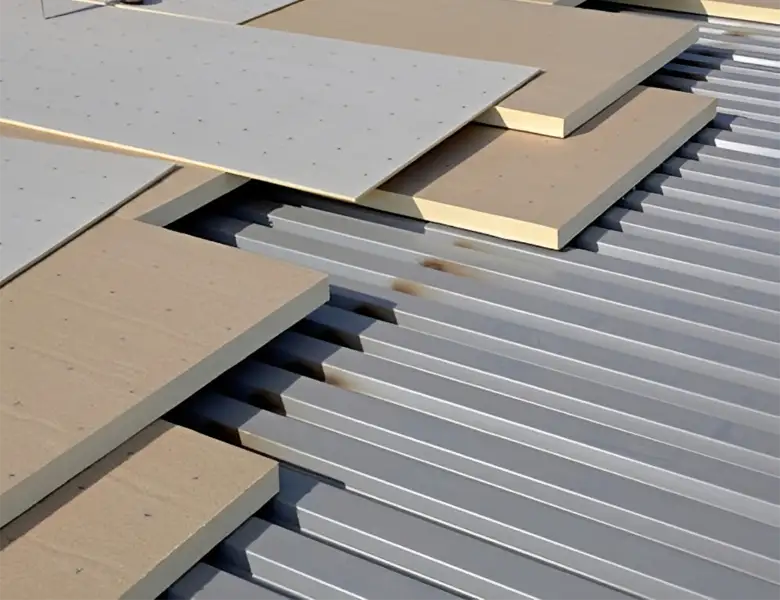
A cover board—typically made of gypsum (like Securock or DensDeck) or high-density polyisocyanurate—is installed over the flat thermal insulation before the TPO membrane is laid down. This dense, rigid layer acts as an impact absorber.
Instead of allowing the hailstone to crush the soft insulation below and over-stretch the TPO, the cover board provides a solid, unyielding substrate. It distributes the kinetic energy of the impact across a wider area, preventing both membrane punctures and sub-surface insulation fractures. Skipping a cover board in a hail-prone region like the Kansas City metro area is essentially planning to buy the same roof repair twice.
How to Assess and Document Damage for Insurance Claims
Filing a successful insurance claim for TPO hail damage requires clear, undeniable proof of “functional impairment.” Insurance adjusters are trained to look for reasons to classify hail impacts as purely “cosmetic,” which is often excluded from coverage.
To build an airtight case, we use a combination of advanced diagnostic methods:
- Visual Mapping: Marking the roof with chalk to identify the frequency of impacts per “square” (a 10′ x 10′ area).
- Seam Probing: Physically running a metal seam tester along all welded joints to find micro-fractures or separations caused by the storm’s energy.
- Thermal Scans (Infrared Imaging): Conducting an infrared moisture survey at night. Wet insulation holds heat longer than dry insulation. A thermal scan reveals exactly where water has bypassed the membrane, even if there are no visible interior ceiling leaks yet.
- Core Sampling: Taking a physical cross-section of the roof assembly down to the deck. This proves whether the underlying cover board or insulation has been fractured or saturated.
To understand how to navigate this process without getting overwhelmed, read our comprehensive resource, The Ultimate Guide to Roof Damage Insurance Claims and Contractors.
Proving Functional Impairment vs. Cosmetic Damage
The battleground of commercial insurance claims is the distinction between cosmetic and functional damage.
Cosmetic damage refers to shallow, aesthetic imperfections—like minor surface smudges or tiny dents—that do not alter the roof’s expected lifespan or its ability to shed water. Functional impairment, however, means the physical integrity of the roof system has been compromised.
To prove functional impairment to an adjuster, we document:
- Splits in the weathering ply using high-resolution macro photography to show exposed reinforcing scrim.
- Fractured insulation facers confirmed via core samples.
- Weakened heat-welded seams that fail a physical probe test, indicating a loss of wind uplift resistance.
By shifting the conversation from “how the roof looks” to “how the roof performs,” we protect our clients from future out-of-pocket costs. For a step-by-step breakdown of how these claims are processed, see our A-Z Guide to Roof Claim Process.
Repair vs. Replacement: Restoring Your Commercial Roof
Once the damage is documented and the insurance claim is underway, the next decision is whether to repair or replace. This choice is heavily influenced by local building codes and the extent of the water migration.
In Missouri jurisdictions like Kearney, Liberty, and Kansas City, building codes generally enforce a two-roof limit. If your building already has two stacked roofing systems (for example, a TPO overlay installed over an older EPDM or modified bitumen roof), code mandates that you cannot add a third. Any further storm damage requires a complete tear-off down to the structural deck.
Furthermore, codes strictly prohibit leaving water-soaked insulation in place. If moisture has migrated widely beneath the membrane, a simple repair is no longer a legal or practical option. For minor, localized issues, a targeted Commercial Roof Repair is highly effective.
Best Practices for Repairing TPO Roofing Hail Damage
When repairing localized punctures or cracks in a TPO roof, the work must be performed in a manufacturer-compliant manner to preserve any existing system warranties.
- Step 1: Deep Cleaning: The damaged area must be thoroughly scrubbed with a specialized TPO cleaner to remove all dirt, UV degradation, and environmental oils. New TPO will not weld to dirty, weathered membrane.
- Step 2: Preparing the Patch: A patch of compatible TPO membrane is cut, ensuring it is rounded (to prevent square corners from peeling) and extends at least 6 inches beyond the edges of the damage in all directions.
- Step 3: Heat Welding: Using a hand-held hot-air welder, the patch is fused to the existing membrane. The welder melts the top ply of the original roof and the bottom ply of the patch together, creating a single, monolithic, watertight barrier.
- Step 4: Seam Testing: Once cool, the edges of the patch are physically probed to ensure a perfect, void-free weld.
We never use temporary caulks, silicone, or generic asphalt sealants on TPO. These materials do not bond properly to thermoplastic membranes and will quickly fail under the summer sun.
When Complete Commercial Roof Replacement is Required
While spot repairs are great for isolated punctures, a complete replacement is the honest and necessary answer under several conditions:
- Staggered, Widespread Damage: If a storm leaves dozens of fractures or insulation dents per square across the entire roof, the labor cost of welding hundreds of individual patches quickly surpasses the cost of a new membrane.
- Saturated Substrate: If thermal imaging or core samples reveal that water has migrated throughout the insulation, leaving it in place will rot the structural wood or steel deck, promote toxic mold growth, and ruin the building’s energy efficiency.
- Aged, Brittle Membrane: As TPO roofs age, they lose their plasticizers and flexibility due to constant UV exposure. If your roof is nearing the end of its useful life, the membrane will be too brittle to accept new heat-welded patches.
In these scenarios, a full tear-off and Commercial Roof Replacement is the only way to safeguard your investment for the next 20 to 30 years.
Frequently Asked Questions about TPO Hail Damage
What size of hail is required to cause functional damage to a TPO membrane?
Generally, hailstones over 2 inches in diameter (roughly the size of a lime or small peach) will cause immediate, critical punctures or fractures in a standard 60-mil TPO membrane. However, if the TPO is older and has been weakened by years of hot Missouri summers, smaller hail (1.25 to 1.75 inches) can easily crack the brittle weathering ply. Conversely, systems built with an 80-mil thick membrane and a high-density gypsum cover board can often withstand larger impacts without sustaining functional damage.
Can hail damage to TPO roofs lead to delayed leaks or progressive deterioration over time?
Yes, absolutely. This is one of the most common ways building owners get caught off guard. A high-velocity hail impact can fracture the fiberglass reinforcing scrim or the backside of the TPO sheet while leaving the top surface looking intact. Over the following months, the daily thermal cycle of hot days and cool nights causes the membrane to expand and contract. This constant physical movement stresses the weakened areas, eventually causing the micro-fractures to open up into active leaks long after the storm has passed.
Does hail damage affect the R-value of roof insulation beneath TPO membranes?
The physical dents caused by hail in polyisocyanurate (polyiso) insulation have a negligible direct impact on thermal performance. Testing shows that even severe denting only reduces the insulation’s R-value by -1.1% to 0.0%, which is practically unmeasurable. However, if those dents go unaddressed and eventually lead to membrane punctures, the resulting water leaks will saturate the insulation. Once polyiso insulation becomes wet, its R-value drops to near zero, leading to massive energy loss and spiked utility bills.
Conclusion
TPO roofing hail damage is a complex, often invisible threat that requires a highly technical approach to diagnose, document, and resolve. From the rapid fading of spatter marks to the hidden fracturing of underlying insulation boards, what you don’t see can hurt your building and your bottom line.
At GNAK Roofing Services, we combine our deep local knowledge of Clay County and the wider Kansas City metro area with rigorous, insurance-ready documentation and manufacturer-compliant workmanship. We don’t just look for leaks; we analyze the structural health of your entire roof assembly to ensure your property remains protected.
If your building has recently experienced a storm, don’t wait for water to start dripping into your workspace. Explore our advanced Commercial Roofing Systems options, or contact us today to schedule a comprehensive, professional inspection.